# Localizing using the Dyspatch API
You have completed building your email draft and are ready to localize the content! Follow along with this guide to understand a technical workflow example using the Dyspatch API.
This guide uses resources from the API documentation to help outline which endpoints to use for each step in a programmatic localizations workflow. For more information on each endpoint, take a look at the Drafts API section.
## Localizing Email State
In order to start this process, you will want to make sure your email draft is in the **Localizing** state.
To move to the **Localizing** draft state, select the **Localizations** tab and click on the **Lock for Translation** button.
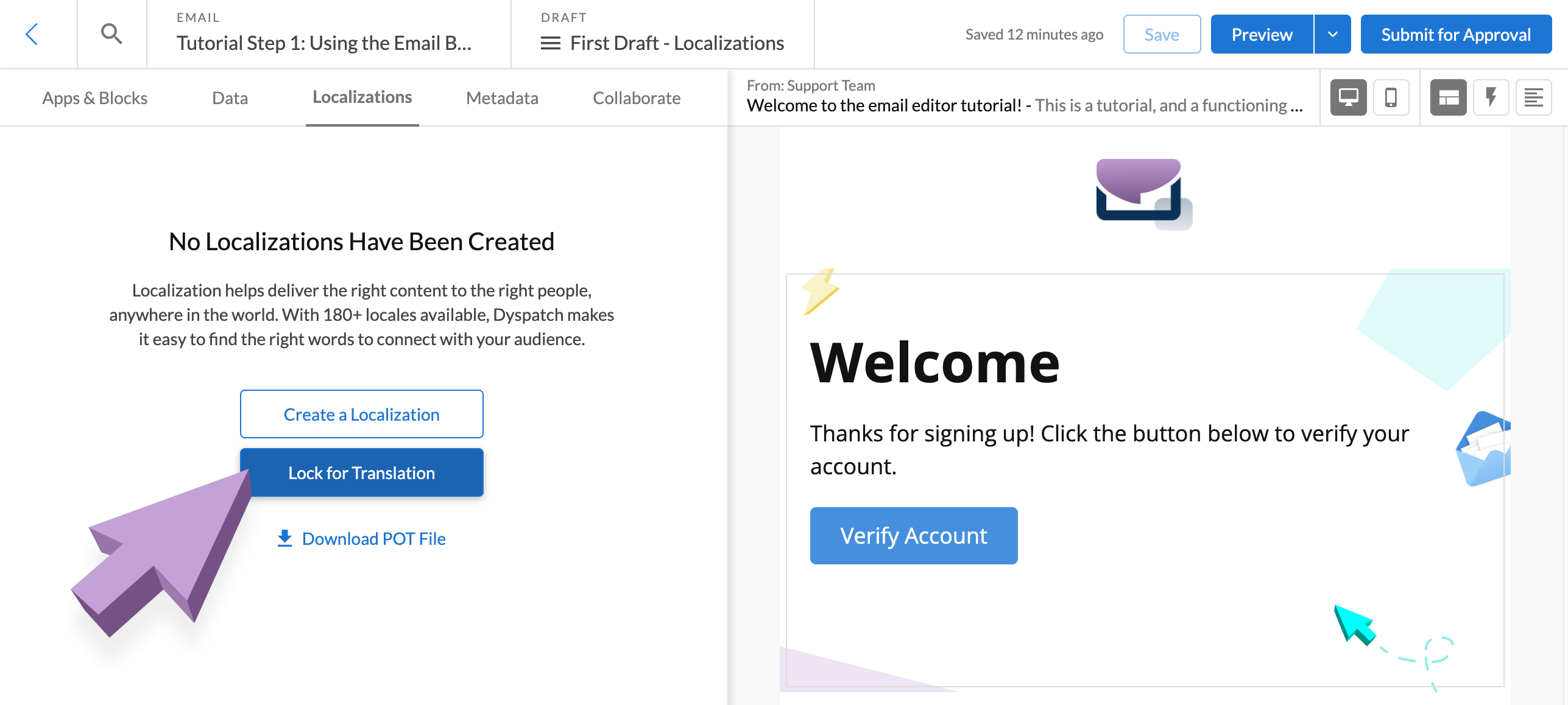
There will be a marker to indicate the draft has been successfully locked for translations with the **Localizing** badge.
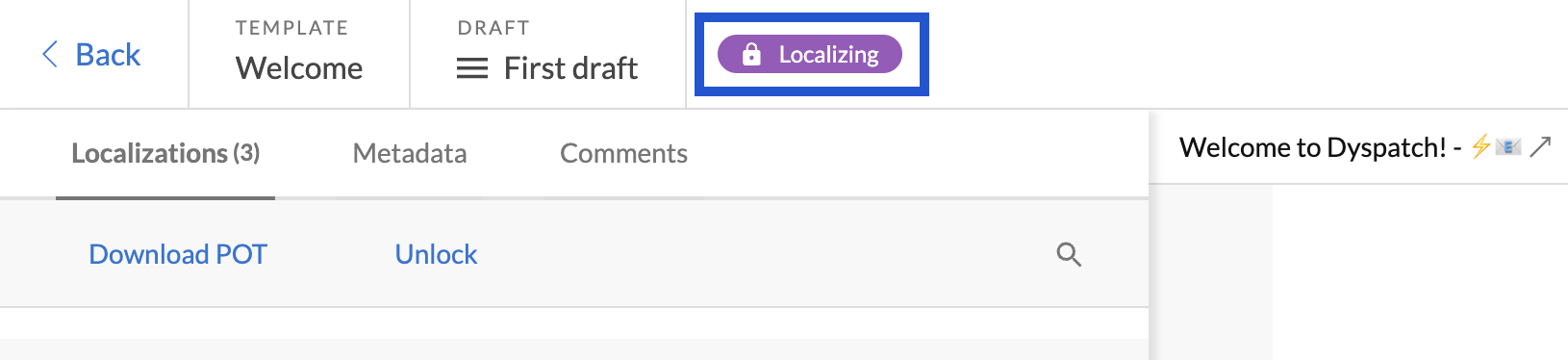
The draft is now locked to prevent any changes from being made during the translation process. These drafts are tagged specifically to allow your system to pull drafts in this state through the API.
## Get Drafts via API
Once the email draft is marked as **Localizing**, the draft is made available through the API. To retrieve a list of all drafts ready for translation, make a request to the `/drafts` API with the `awaitingLocalization` query parameter.
**Request URL:**
```bash
GET https://api.dyspatch.io/drafts?status=awaitingTranslation
```
**Response:**
```bash
{
"cursor": {
"hasMore": false,
"next": ""
},
"data": [
{
"createdAt": "2026-03-01T18:57:06Z",
"id": "tdft_01ds66130r2t2z4h47p7dt4",
"name": "First Draft - Localizations",
"path": "fdr_01hpj7ccxzfcg1m1d4oszf3k7s",
"status": "LOCKED_FOR_TRANSLATION",
"templateId": "tem_01ds63931fbsgcn0gmgh5zz",
"templateName": "Tutorial Step 1: Using the Email Builder",
"updatedAt": "2026-03-01T23:01:13Z",
"url": "https://api.dyspatch.io/drafts/tdft_01ds66130r2t2z4h47p7dt4",
"workspaceId": "fdr_01hpj7ccxzdcg1m1d3mszf3k3s"
},
...
]
}
```
**Sample Curl Request:**
```curl
curl --request GET \
--url 'https://api.dyspatch.io/drafts?status=awaitingTranslation' \
--header 'accept: application/vnd.dyspatch.2026.01+json' \
--header 'authorization: Bearer API-KEY'
```
Replace the `API-KEY` to use the curl request.
## Localizing a Draft
To create a localization for the draft, make a request to the Create/Update a Localization API. The request URL `/drafts/{draftId}/localizations/{languageId}` will take a `draftId` and a `languageId`.
The `draftId` will be the matching draft ID from the above request. The `languageId` will be any valid locale code (e.g. "en-US"). [Click here for a full list of supported locales](/localization/supported_languages/#supported-languages).
Sending a request using this endpoint will either overwrite a previously created localization or create a new localization.
**Request URL:**
```bash
PUT https://api.dyspatch.io/drafts/tdft_01ds66130r2t2z4h47p7dt4/localizations/fr-FR
```
**Request Body:**
```bash
{
"name": "French (France)"
}
```
**Response:**
```bash
200 OK
```
**Sample Curl Request:**
```curl
curl --request PUT \
--url https://api.dyspatch.io/drafts/tdft_01ds66130r2t2z4h47p7dt4/localizations/fr-FR \
--header 'accept: application/vnd.dyspatch.2026.01+json' \
--header 'authorization: Bearer API-KEY' \
--header 'content-type: application/json' \
--data '{
"name": "French (France)"
}'
```
Replace the Template Draft ID `tdft_` and the `API-KEY` to use the curl request.
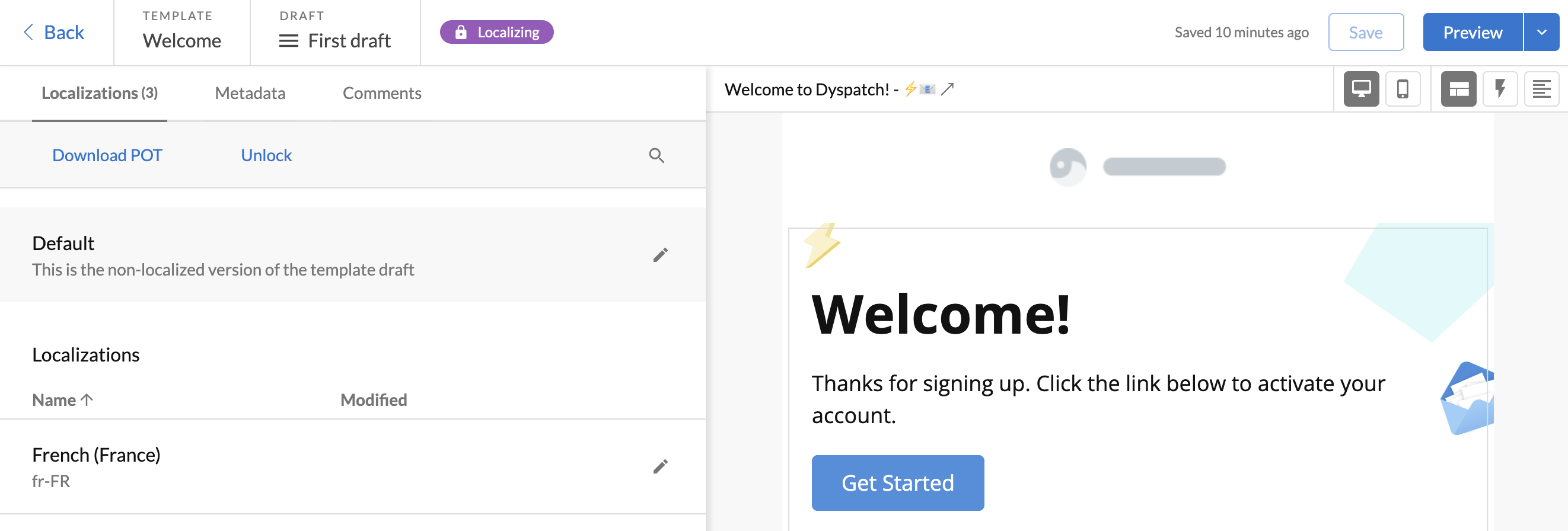
## Get the Localizations Keys for a Draft
Once the localizations have been created on the draft, you will want to fetch the localization keys.
A localization key will be a content piece from your email draft. This typically includes content such as copy, but can also include any URLs and image sources. These keys will be the content you will want to translate and send to your translations team.
Set the `Accept` header to `application/vnd.dyspatch.2026.01+json` to get a **JSON object** with the keys.
Set the `Accept` header to `text/vnd.dyspatch.2026.01+x-gettext-translation` to get a **POT file** with the keys.
The
2026.01 will be the version of the API you're targeting. Take a look at which versions are available:
API changelog.
Set Content-Type header to application/json for JSON, or text/x-gettext-translation for PO file.
**Request URL:**
```bash
PUT https://api.dyspatch.io/drafts/tdft_01ds66130r2t2z4h47p7dt4/localizations/fr-FR/translations
```
**Request Body - JSON object:**
```bash
{
"welcome to %(company_brand)s": "bienvenue en %(company_brand)s",
"thanks for signing up!": "merci pour l'enregistrement!",
"Verify Account": "Vérifier le Compte",
"https://app.dyspatch.io/welcome?lang=en-US": "https://app.dyspatch.io/welcome?lang=fr-FR"
}
```
or
**Request Body - PO file:**
```bash
# GENERATED USING DYSPATCH
# FOR HELP CONTACT SUPPORT@DYSPATCH.IO
#
#, fuzzy
msgid ""
msgstr ""
"MIME-Version: 1.0\n"
"Content-Type: text/plain; charset=UTF-8\n"
"Content-Transfer-Encoding: 8bit\n"
#, python-format
msgid "welcome to %(company_brand)s"
msgstr "bienvenue en %(company_brand)s"
msgid "thanks for signing up!"
msgstr "merci pour l'enregistrement!"
msgid "Verify Account"
msgstr "Vérifier le Compte"
#. localization for 'href' property of 'Verify Account'
msgid "https://app.dyspatch.io/welcome?lang=en-US"
msgstr "https://app.dyspatch.io/welcome?lang=fr-FR"
```
**Response:**
```bash
200 OK
```
**Sample Curl Request:**
JSON Object
```curl
curl -i --request PUT \
--url https://api.dyspatch.io/drafts/tdft_01ds66130r2t2z4h47p7dt4/localizations/fr-FR/translations \
--header 'accept: application/vnd.dyspatch.2026.01+json' \
--header 'authorization: Bearer API-KEY' \
--header 'content-type: application/json' \
--data '{
"welcome to %(company_brand)s": "bienvenue en %(company_brand)s",
"thanks for signing up!": "merci pour l'\''enregistrement!",
"Verify Account": "Vérifier le Compte",
"https://app.dyspatch.io/welcome?lang=en-US": "https://app.dyspatch.io/welcome?lang=fr-FR"
}'
```
PO File
```curl
curl -i --request PUT \
--url https\://api.dyspatch.io/drafts/tdft_01ds66130r2t2z4h47p7dt4/localizations/fr-FR/translations \
--header 'Content-Type: text/x-gettext-translation' \
--header 'Authorization: Bearer API-KEY' \
--header 'Accept: application/vnd.dyspatch.2026.01+json' \
--data msgid\ \"\"'
'msgstr\ \"\"'
'\"MIME-Version\:\ 1.0\\n\"'
'\"Content-Type\:\ text/plain\;\ charset\=UTF-8\\n\"'
'\"Content-Transfer-Encoding\:\ 8bit\\n\"'
'\#\,\ python-format'
'msgid\ \"welcome\ to\ \%\(company_brand\)s\"'
'msgstr\ \"bienvenue\ en\ \%\(company_brand\)s\"'
'msgid\ \"thanks\ for\ signing\ up\!\"'
'msgstr\ \"merci\ pour\ l\'enregistrement\!\"'
'msgid\ \"Verify\ Account\"'
'msgstr\ \"V\érifier\ le\ Compte\"
```
Replace the Template Draft ID `tdft_` and the `API-KEY` to use the curl request.
This action will update the specified language code with the translated keys.
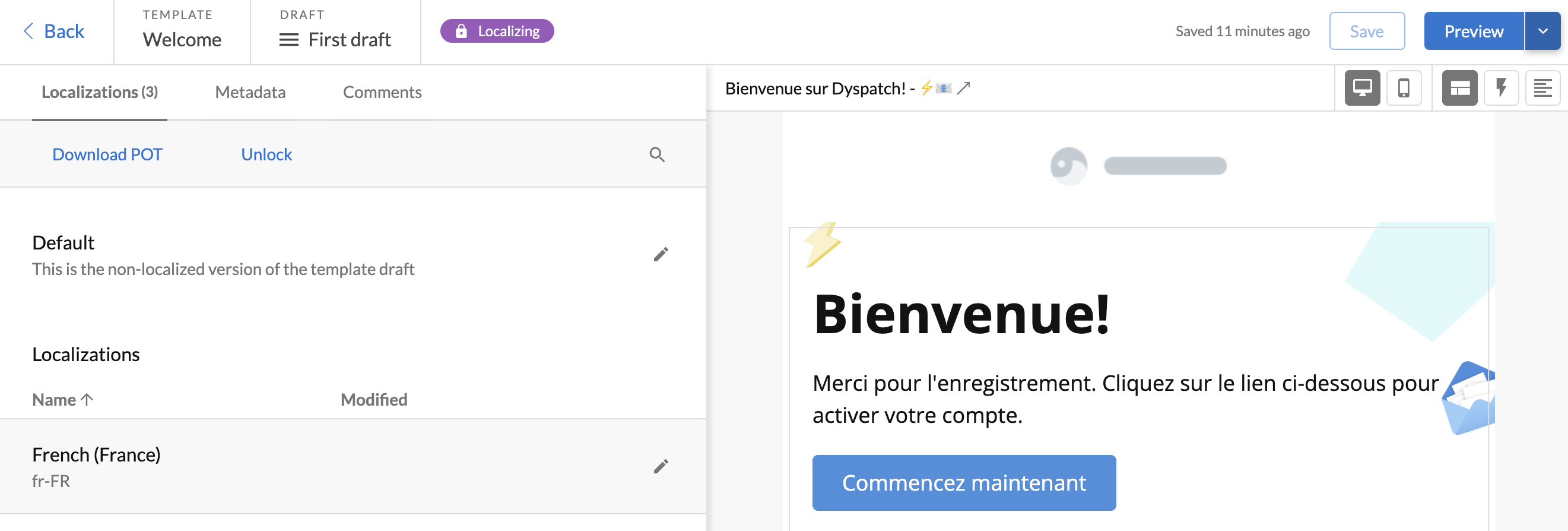
## Submit Email for Approval (Optional)
You can optionally submit the email for approval via the API. If you choose not to do this automatically, you can still manually [submit for approval via the dashboard](https://docs.dyspatch.io/emails/submitting_an_email/#submit-for-approval).
**Request URL:**
```bash
POST https://api.dyspatch.io/drafts/tdft_01ds66130r2t2z4h47p7dt4/publishRequest
```
**Response:**
```bash
200 OK
```
All set! Your email draft will now be [waiting for approval](/emails/submitting_an_email/#awaiting-approval). Your email stakeholders will be able to review the email, reject the approval to provide comments and feedback, or approve and publish the draft.
## Checking Draft Stage with Two-Step Approvals
If your team has [two-step approvals enabled](/emails/submitting_an_email/#localization-approval-workflow), a draft passes through approval twice, once for the design (step 1) and once for the localized content (step 2). Both stages report the same `PENDING_APPROVAL` status, so status alone won't tell you which one a draft is sitting in.
Use the draft's `designApprovedDate` field to tell them apart:
- **Empty** — the draft is in the design stage, awaiting design approval.
- **Set to a date-time** — the design has already been approved, so the draft is in the localization stage.
The field is returned by the List Drafts endpoint, so you can branch your automation on it without an extra request.
## Fully Automated Localization Workflow
Need to make translation changes to an email that has already been published? Here's what a fully automated workflow would look like in action:
#### Phase 1: Creating & Approving the Design
1. **Retrieve the Target Email**: Make a Get Template by ID `(GET /templates/{templateId})` request to grab the `publishedDraftId`.
2. **Duplicate the Draft**: Using the `publishedDraftId` from step 1 as `{draftId}`, make a Duplicate Draft request `(POST /drafts/{draftId}/duplicate)`. Be sure to pass a name for your newly duplicated draft!
3. **Pass the "Design" Stage** (Optional): If your team has [two-step approvals enabled](/emails/submitting_an_email/#localization-approval-workflow), you will need to clear the design phase. Use the API to Submit Draft for Approval `(POST /drafts/{draftId}/publishRequest)`, and then immediately Approve the Draft `(POST /drafts/{draftId}/publish/approve)`.
#### Phase 2: Kicking Off Localization
1. **Lock the Draft**: Once the design is approved, use the Lock Draft for Translation `(PUT /drafts/{draftId}/lockForTranslation)`.
2. **Trigger Your Translation Pipeline**: Locking the draft will [trigger a webhook](/integrations/setting_up_webhooks/) (`template_locked_for_translation`) from Dyspatch. You can use this webhook to automatically trigger your external localization process. [Get the localizable content](/localization/localizing_workflow/#localizing-a-draft) and send the content to a Translation Management System or external agency.
#### Phase 3: Finalizing the Localized Email
1. **Final Review & Approval**: Once the localization process is completed and synced back, use the API to Submit the Draft for Approval once more.
2. **Publish**: For the final approval, you have ultimate flexibility. You can have a stakeholder review and approve the finalized, translated email manually in the Dyspatch app, OR you can keep it fully automated by hitting the Approve Draft endpoint one last time to ready it for production.