# Exporting a Dyspatch Email to AWS SES
Build beautiful emails quickly with Dyspatch and send them to your customers
using Amazon's Simple Email Service.
# Downloading Your Email Email
Once your email has been reviewed and [approved by your team's
stakeholder](/emails/submitting_an_email/#draft-approved), you can now
export your email using the **Export** button.
You will need to click the **Download Icon** in the Amazon SES option to be compatible with
SES's templating system.

A zipped file will be downloaded onto your system with the HTML, plain text
content, metadata, and localizations (if applicable).
### Putting the Email in SES
SES emails are created through the [AWS
API](https://docs.aws.amazon.com/ses/latest/DeveloperGuide/send-personalized-email-api.html#send-personalized-email-create-template).
We recommend setting up an API integration
with Dyspatch so your emails can always be in sync.
You can also use AWS's API directly to create emails. The script below
assumes you have jq installed and the AWS
CLI tool correctly set up.
First, save the below script as "upload.sh"
```sh
#!/usr/bin/env sh
DIR="/tmp/template"
# Extract the template to /tmp/template
unzip "$1" -d $DIR
# Set up variables
file="`ls $DIR/*.html`"
html_file="${file##*/}"
template_name="${html_file%%.*}"
metadata_file="$template_name-metadata.txt"
# Escape Name
ses_template_name="`echo $template_name | sed -Ee 's/[[:blank:]]+/_/g'`"
# Test for optional txt file
if test -f "$DIR/$template_name.txt"; then
txt_file="$template_name.txt"
txt_content="`cat $DIR/$txt_file`"
else
txt_content=""
fi
# Get subject line
subject="`cat \"$DIR/$metadata_file\" | grep 'Subject:' | awk '{sub($1 FS, ""); print}'`"
# Get template content
html_content="`cat \"$DIR/$html_file\"`"
# Construct the JSON object
jq --null-input\
--arg html "$html_content"\
--arg txt "$txt_content"\
--arg subject "$subject"\
--arg name "$ses_template_name"\
'{"Template": {"TemplateName": $name, "SubjectPart": $subject, "HtmlPart": $html, "TextPart": $txt}}'\
> $DIR/template.json
# Upload to AWS
aws ses create-template --cli-input-json file://$DIR/template.json
echo "Uploaded template: '$template_name'"
```
Then, make the script executable
```sh
$ chmod +x upload.sh
```
Now you can upload the Dyspatch email in the zip file you downloaded. Make
sure to replace `[Dyspatch Template Name]` with the actual file name!
```sh
$ ./upload.sh "[Dyspatch Template Name].zip"
```
Verify that the email was uploaded by going to **SES** > **Email
Templates**.
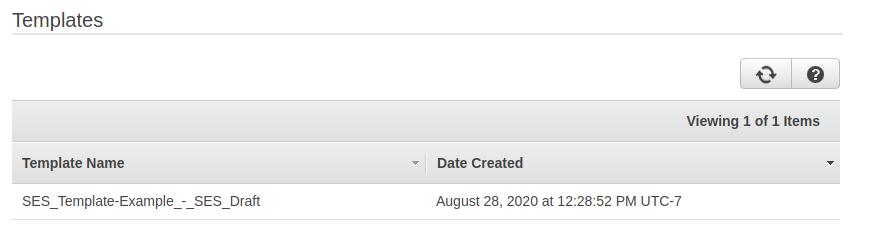 You're done! Your email is now ready to send through SES.